Typical Targets
- Disintegration (sublingual): 10–30 s
- Thickness tolerance: ±5–8%
- Content uniformity: per pharmacopeia
- Residual moisture: per formula spec
Overall Mechanism
An ODF machine converts a casting solution into finished unit packs via a closed loop—solution prep → precision coating → zoned drying → winding/slitting → camera-registered die-cutting → high-barrier unit packaging. Performance hinges on the synergy of coat quality, drying mass transfer, and web-tension control.
Solution Readiness
The make-up system handles dissolution, dispersion, and vacuum de-aeration, then stabilizes viscosity and temperature. Inline filtration and solids/rheology windowing align drying shrinkage with the target dry thickness (typically 50–120 μm), reducing curl and orange peel.
Precision Coating & Closed Loops
A slot-die or doctor blade deposits a metered wet film. Closed-loop tension and web guiding keep the substrate stable, while edge-beading control and backing-roll geometry limit cross-web variation. Inline thickness/weight/vision metrology feeds back to gap, flow, or line-speed setpoints for real-time stabilization.
Zoned Drying & Transport Phenomena
The oven uses multi-zone temperature with adjustable airflow. Early low-temperature stages prevent skinning; mid zones shape the vapor-transport gradient to avoid pinholes and bubbles; the final zone relaxes stress for a flat film with consistent mouthfeel. Alcohol systems integrate solvent recovery and explosion protection.
Slitting, Die-Cutting & Unit Dose
After stable winding, servo slitting and camera-registered die-cutting reproduce the dose layout into individual strips. Packaging applies 4-side seals or blisters with nitrogen/desiccants as needed. WVTR/OTR validation and shipping-humidity profiles protect shelf life and flavor/API integrity.
Quality & Data Loop
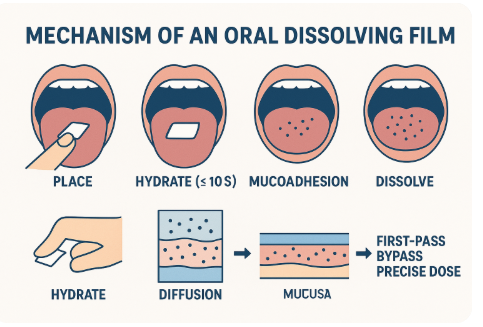
Release targets include seconds-level dissolution (e.g., ≤10 s), dose uniformity (e.g., CV ≤ ±2–3%), thickness/GSM, residual moisture/water activity, and sensory consistency. SPC and batch records link prep → coat → dry → cut → pack, enabling traceability, auditability, and rapid corrective action.
Previous:What is a Buccal Film
Feasibility, scale-up and GMP contract manufacturing for sublingual films.
Contact UsDirect line: 0086 15135166470 · Email: pengchengshi@biotechrs.com / pcspc9@gmail.com