Typical Targets
- Disintegration (sublingual): 10–30 s
- Thickness tolerance: ±5–8%
- Content uniformity: per pharmacopeia
- Residual moisture: per formula spec
Goal & Approach
Vitamin ODFs must balance assay/stability, seconds-level dissolve, palatability, and manufacturability. Anchor on target dose and use scenario, then back-calculate the matrix, plasticizer level, flavor, and drying window with scale-up headroom.
Matrix & Thickness
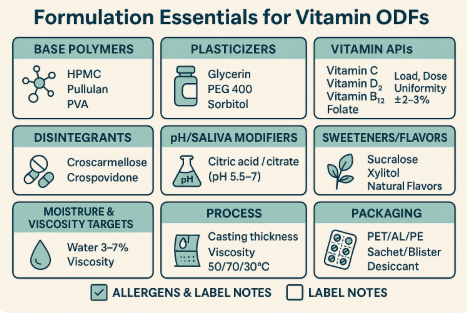
HPMC, pullulan, and PVA are common; small blends with pectin/alginate can boost strength and fast melt. Typical dry thickness 50–120 μm. Polymer MW and ratios shape clarity, toughness, and dissolution kinetics.
Plasticization & Moisture Control
Glycerin, sorbitol, maltitol, and PEG 400 improve flexibility and glide; too much = tack/slow dissolve, too little = brittleness. Keep residual moisture/water activity in a tight window to avoid curl, cracking, and flavor fade.
Vitamin Handling Strategy
Water-soluble (C, B-complex) disperse readily but need taste masking and buffering to curb bitterness/acidity and protect stability. Fat-soluble (D3, E, K2) benefit from emulsified powders, microencapsulation, or solid dispersions to achieve stable fine dispersions and prevent oil spotting/precipitation. ODFs suit low–to–moderate loads; high payloads must be assessed for effects on film strength and dissolve.
Taste, micro-pH & Solubilization
Use non-sugar sweeteners (sucralose/acesulfame K/stevia) with citrus/berry/mint; light cooling agents can enhance freshness. Set micro-pH with citric/citrate or malic buffers to support stability/dissolution and stimulate saliva. For poorly soluble or transmucosal-leaning designs, apply compliant surfactants/cyclodextrins/mild enhancers and verify oral tolerance.
Process & QC Essentials
Flow: solution prep (dissolution/dispersion/deaeration) → precision coating → zoned drying → slitting/die-cut → high-barrier packing. Employ inline thickness/gravimetric/vision controls. Release on dissolution (e.g., ≤10 s), dose uniformity (CV ≤ ±2–3%), thickness/GSM, residual moisture, and sensory consistency; complete accelerated and real-time stability.
Packaging & Logistics
Adopt high-barrier 4-side seals or blisters with desiccants/nitrogen as needed. Validate WVTR/OTR and shipping-humidity profiles to prevent deliquescence, curl, and loss of API/flavor performance.
Feasibility, scale-up and GMP contract manufacturing for sublingual films.
Contact UsDirect line: 0086 15135166470 · Email: pengchengshi@biotechrs.com / pcspc9@gmail.com